
We talk a lot about movement – the miles run, the yoga flows, the heavy lifts. Now let’s talk about the space we return to afterwards.
Here is how I hacked my environment to support my movement, even though I have zero interior design instincts.
Design for the downshift (the lighting hack)
In movement, we have the up-regulation (the workout) and the down-regulation (the rest). If you come home to harsh, overhead big lights, your nervous system stays in a state of high alert.
I don’t have an eye for colour palettes, but I know how to create a mood.
The move: Kill the big light. Use small lamps at eye level or lower.
The result: It signals to your brain that the active phase of the day is over. It’s the domestic version of a Savasana.
Clear a path for daily flow
When you don’t have the eye, your flat can quickly become a graveyard of gear – yoga mats in the corner, foam rollers under the bed. This is visual noise that creates mental friction.
I stopped trying to make my flat look like a magazine and started making it look like a functional studio. I dedicated one sacred corner to movement. Just one. No clutter allowed.
Movement beyond the four walls
Here is the secret: a restorative home isn’t just about what’s inside. It’s about how you move through your neighbourhood.
I stopped feeling like a guest in my flat when I started building micro-rituals in my postcode.
Use your morning walk to the cafe to become a regular.
Get your Vinted deliveries sent to the same corner shop.
Pick a favourite dog in the park and learn its name.
When the local barista or the auntie at the off-license recognises you, your flat stops being a box you rent. It becomes your base camp. You aren’t just passing through. You are part of a local ecosystem.
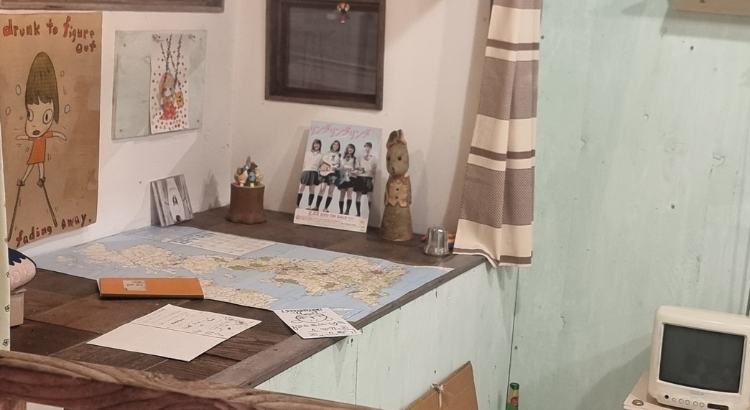
Photo: Yoshitomo Nara exhibition at Southbank Centre